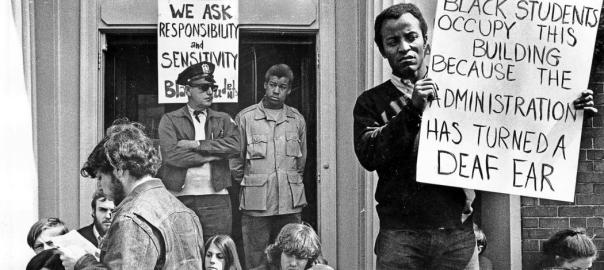
Evanston, Ill- After a historic spike in Black matriculation at Northwestern University over the past three years, you would think it would be easier for administrators and Black students to collaborate and acculturate, but that is not the truth felt by many Black students on campus.
“One of the things I learned at Northwestern was how to support myself because no one else is there to support you, especially being Black,” said Northwestern University class of 2017 graduate and former Associated Student Government executive-vice president Lawrence “Macs” Vinson, 22.
Oddly as Northwestern has made the push to create a healthier and safer community for its Black students, the more Black students have felt isolated and forgotten by the university, according to interviews with past and present students. This may be a result of of past events and facts including the substantially low percent of Black students on campus which has not surpassed 10% as an undergraduate population in 33 years, according to Northwestern University’s demographic data.
“There is very much difference between diversity and inclusion here. There’s 10% Black students in the class of 2021, but we’re not included in anything,”noted Taylor Bolding, 18, President of the Freshman Executive Board for Northwestern’s Black Student Union.
It is often debated in academia, especially in today’s climate, if it is the students or the university’s job to create an inclusive and accepting environment for students of color on campuses.
Elizabeth Aries, Professor of Psychology at Amherst College and author of Speaking of Race and Class: The Student Experience at an Elite College (2012) said, “The college has to lead the way on creating an inclusive environment. They can’t bring people in and not help build something inclusive. They are inviting students of color into a space where they are not comfortable, not knowledgeable, and not fully prepared for what they are going to encounter.”
Many Black student’s on campus agree, especially when relating to Sustained Dialogues on campus, which were started in 2015. Sustained Dialogue is a “student-facilitated program that encourages conversation across lines of difference with other Northwestern students”, according to Northwestern’s website.
“I personally did not feel like it was my requirement to teach white people how to engage with me and try to understand me,” said Northwestern University class of 2016 graduate and former community organizer Matthew Wright, 23, on why he feels it should not be the students job to educate their peers.
The birth of Sustained Dialogue can be directly linked to an event during the 2015-2016 school year, when the university attempted to reorganize the setup of the Black House on campus, which is the only historical Black site on campus where students of color gather every single day. This setup would have moved many administrative offices into the Black House and disrupted the solidarity and commodity that Black students had developed there, according to former Northwestern students.
“[The Black community] was really struggling, especially with all of the conflict with the Black house. It was really difficult to keep Black people motivated and accountable on campus when they didn’t feel supported,” said Wright.
The university has since realized that having the Black House and other spaces like ‘home’ are extremely important to all students in a place where they don’t feel necessarily supported or comfortable on campus.
This was reaffirmed by Dr. Lesley-Ann Brown-Henderson, the Director of Diversity and Inclusion at Northwestern University, when she said, “[Northwestern] has staff in the Black House and the MCC aimed at creating home communities for student. We want students to feel at home in our spaces as well as outside of our spaces.”
The Black House controversy also led to Northwestern releasing “The African American/ Black Student Experience” curated by the Black Student Experience Task Force during the subsequent summer of the Black House issues.
However, this report showed that the distrust between the Black community and the administration at Northwestern has caused many Black students to downplay any attempts made by the school to foster a more inclusive community for Black students on campus.
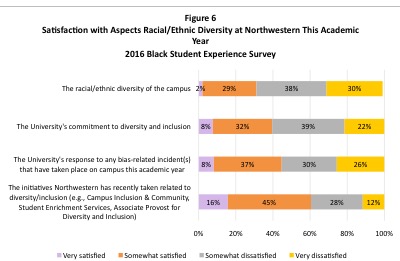
The African-American/Black Student Experience Report
When confronted about this idea Dr. Lesley-Ann Brown-Henderson pondered for almost a whole minute before saying, “I could see how students would see that or say that. I work on the ground every day with a lot of staff who are working really hard to make Northwestern different, so of course my perspective is different. I know [faculty] are on the ground doing work with students and I think sometimes perhaps students aren’t feeling it as directly as they would like to.”
It is evident that the Black community is not completely satisfied with their experience on campus, but they have significantly failed at voicing their dissatisfaction with both the administrators and their peers.
“I thought the TND on diversity was a really powerful one, especially for marginalized groups, and I thought the university was doing a good job on trying to get student’s to support each other.”, said Northwestern freshman Christian Braun , 19, who identifies as a white male and republican.
That opinion is almost directly opposite from most of the Black community, but for the most part their peers don’t know that.
At the end of the day, no matter how students feel about their experience at Northwestern, all of the power lies with the administrators and their actions towards how they support their students, no matter of their race.
“When students ask for change at a university, the school has two choices: they can either acquiesce with the demands to a certain event or just wait it out,” said Vinson on what’s the next move for Northwestern University.
 Honey Media Collective
Hello Adam Mahoney, I am Jonathan Thompson a 2014 Bridge Builder Scholar. Dr. Wayne Moore informed me on the article you published. This is a very informative article. I believe other universities with a low enrollment rates for blacks at there campus can relate to this as well. It’s upsetting to hear but I have friends who have shared the same experiences. I’m interested to know more on the Sustained Dialogue Program you mentioned. Is it a mandatory program that your required to do? Also how are the other ethnic Latino/Asian Pacific Student Unions holding up. You might be able to gain a larger support to revamp the Black House if they are experiencing similar struggles.
LikeLiked by 1 person
Hello Jonathan, thanks for reading! Sustained Dialogue is required during the week of freshman orientation, but not after that. It can be seen as an open forum or discussion around certain topics like race, gender,etc. The other ethnic groups on campus are actually less funded and organized than the Black community, which is sad, but not necessarily surprising.
LikeLike